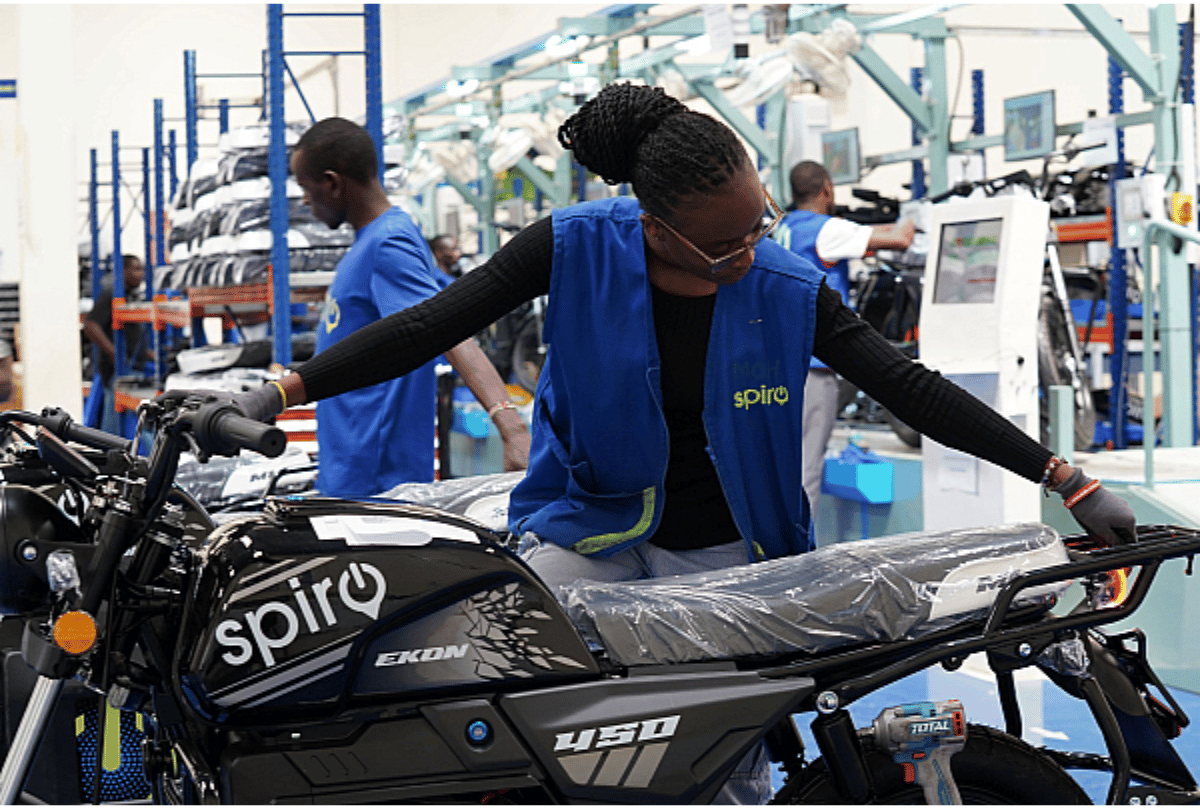
Spiro, the Kenyan electric mobility and clean energy infrastructure platform, has closed a $270 million funding round — making it the most heavily backed EV company on the African continent. The fresh capital is anchored by a new $55 million investment from NewTrails Capital, a Chinese growth-stage fund with strategic presence in Shanghai, Shenzhen, and Nigeria.
The story underneath the headline is bigger than the dollar figure. Spiro has already deployed 100,000 electric vehicles and 2,500 smart-swap stations across seven active African markets, which means the company isn't pitching an African EV dream — it's reporting an operating business that has crossed the proof-of-concept line.
What Spiro actually does
Spiro operates an integrated electric mobility and energy infrastructure platform. The two pieces that matter:
- Electric two-wheelers, primarily motorcycles and scooters, deployed for commercial transport and last-mile delivery use cases
- Battery swap stations (the "smart-swap" reference) that let drivers exchange depleted battery packs for charged ones in minutes, rather than waiting for a charging cycle
This is the same architecture that Nio has been deploying at scale in China, but adapted to African market conditions: lower per-vehicle price point, higher utilization rates per vehicle, and operating environments where home charging isn't the assumed default.
The model is genuinely interesting for a reason most EV coverage misses: two-wheelers are the dominant vehicle class across most of Africa. Motorcycle taxis, delivery bikes, and shared-mobility scooters are how people and goods move in cities like Lagos, Nairobi, Kampala, Kigali, and Dar es Salaam. Electrifying that segment at scale has the same emissions impact — per dollar invested — that electrifying SUVs does in the US or Europe. And the unit economics work because the vehicles operate at high utilization rates that justify the upfront cost.
What $270M signals
Spiro's funding round draws capital from a deliberately diverse pool:
- NewTrails Capital (China) — the new $55M lead, bringing emerging-markets growth-stage expertise and a Shanghai/Shenzhen/Nigeria operational footprint
- FEDA (Fund for Export Development in Africa) — a long-standing institutional partner
- Impact Fund Denmark (Europe)
- Equitane (Africa)
- Nithio (US/international climate finance)
- Africa Go Green Fund
That investor mix is the story most coverage skips. Spiro has attracted institutional capital from three continents for a business operating in African markets that Western EV investors have historically written off. The new Chinese anchor is especially notable: NewTrails Capital's involvement signals that Chinese EV capital — the same capital that has driven the buildout of BYD, Nio, and the broader Chinese EV ecosystem — now sees African two-wheeler electrification as a real investment category, not a charitable side bet.
Why Africa matters for EVs now
Most EV coverage focuses on China, Europe, and the US. That's where the volume is, where the brands are most familiar, and where the policy frameworks are most developed. Africa gets a passing mention every few months, usually in the context of a single country trying to skip the gasoline phase entirely.
But Africa matters for reasons that aren't visible from a US- or Europe-centric vantage point:
- Two-wheeler transport is the dominant mode. Motorcycles and scooters dominate urban transport in most African cities. Electrifying them at scale produces immediate emissions reductions without requiring a parallel buildout of car-oriented infrastructure.
- Battery swapping fits the use case better than home charging. Most African motorcycle operators don't have garages, driveways, or reliable grid access at their homes. A network of swap stations is the right architecture, not the wrong one.
- Falling lithium prices reshape the math. The same battery cost decline that has made Chinese EVs affordable has made African EV two-wheelers economically viable in the last three years.
- African cities are rapidly urbanizing. The window for setting the urban transport template is open right now. Cities that build EV-first infrastructure now will not have to retrofit later.
The investment that flows into Spiro now is, in part, a bet on which urban transport model Africa locks in over the next decade. If motorcycle electrification scales, the rest of the EV transition gets easier. If it doesn't, African cities lock in combustion two-wheelers for another generation.
What Spiro's 100,000-vehicle, 7-market number actually means
Spiro has 100,000 electric vehicles on the road in seven African markets and 2,500 battery swap stations operational. By global EV industry standards, those numbers are modest. By African EV industry standards, they are an order of magnitude larger than anything else on the continent.
The 2,500-station figure is the more important number. Battery swap infrastructure is the binding constraint on motorcycle electrification in any market. Stations need to be dense enough that drivers don't lose hours of productive time on charging cycles. They need to be in safe, accessible locations. They need to be financially sustainable on a per-swap basis.
Spiro has built that infrastructure at meaningful density across multiple markets. That's not a startup pitch — that's an operating business.
What the NewTrails partnership specifically brings
The new $55M from NewTrails Capital isn't just a financial injection. Per Spiro's announcement, the partnership is "instrumental to support Spiro's current manufacturing and supply chain localisation effort on the continent in particular with Chinese suppliers."
That's the operational detail most coverage will miss. Spiro is using Chinese capital to integrate Chinese EV supply chains into African manufacturing. The strategic intent is clear:
- Reduce per-vehicle cost by manufacturing locally rather than importing complete vehicles
- Reduce foreign exchange exposure by sourcing components and assembly in regional currencies
- Build local technical expertise that doesn't depend on expatriate engineering teams
This is the playbook Chinese OEMs have used to enter markets from Brazil to Thailand. The fact that it's now being applied to African two-wheeler electrification — with Chinese growth capital underwriting it — is a meaningful signal about how the global EV supply chain is reorganizing.
What to watch over the next 12 months
- Spiro's market expansion. Spiro has seven active markets today. The $270M should fund expansion to additional countries in West and East Africa. Watch the announcement cadence.
- Local manufacturing scale. Spiro has signaled manufacturing and supply chain localization as a priority. If assembly plants come online in new African markets over the next 12–18 months, the cost-down story gets real.
- Whether other African EV players raise. Spiro's $270M will be read as a market-validation signal by other African EV operators. Watch whether new funding rounds follow.
- Whether Chinese OEM partnerships deepen. If Spiro or a peer announces a strategic partnership with a major Chinese OEM (BYD, Nio, or a smaller player) for technology licensing or vehicle supply, that's a structural shift, not just a funding event.
The verdict
Spiro's $270M isn't just a big African EV funding round. It's the moment the African EV story stops being a curiosity and starts being a category. The combination of operating scale (100,000 vehicles, 2,500 stations), institutional capital (from three continents), and supply chain integration (with Chinese OEM partners) is the model that makes African EV electrification a real industrial story, not a development-aid narrative.
For most Western EV coverage, Africa has been a footnote. After this round, it's going to be a category. The next 18 months will tell us whether Spiro's model scales to additional markets at the same rate, or whether the operating complexity of African EV infrastructure catches up with the growth story.
Either way, the signal is the same: the global EV transition is no longer a three-region story.
Source: TechAfrica News — Spiro Raises $270M to Scale Electric Mobility and Energy Infrastructure Across Africa. 22 June 2026. AutoWheeler analysis built on the source reporting; opinion and interpretation are our own.