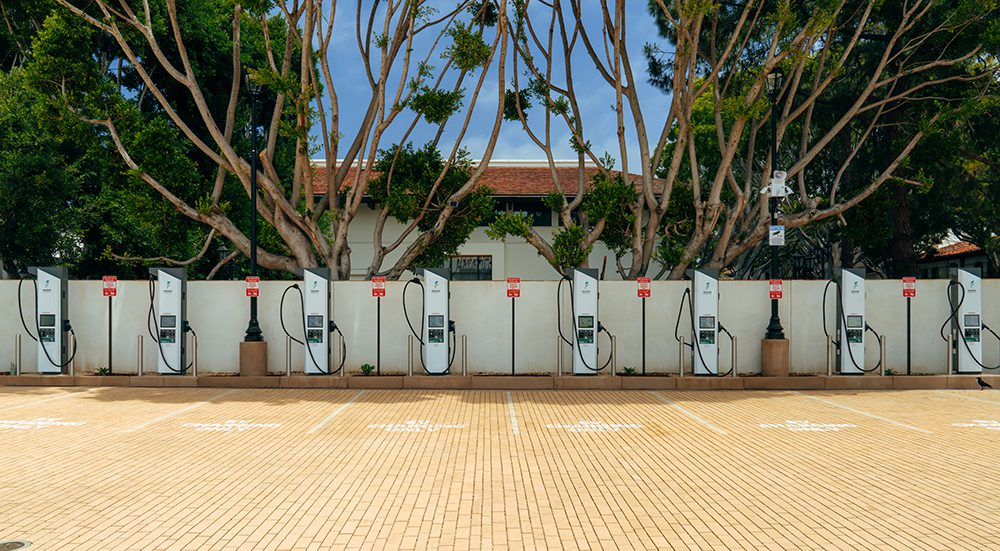
Electrify America opened a new public charging station in downtown Santa Barbara this week, on the site of a former Greyhound bus depot. The headline numbers are 20 chargers, each capable of 350 kW peak charging.
The real story is the 1.9 MW battery energy storage system sitting behind the chargers.
That's Electrify America's largest public battery storage deployment to date, and it's the piece that makes the rest of the station work in dense urban locations where the grid would otherwise balk at the load.
What's actually at the site
The new station sits on Carrillo Street in downtown Santa Barbara. Twenty chargers, each rated to 350 kW peak DC fast charging, all equipped with CCS connectors at launch. Electrify America has signaled that some of the connectors will convert to NACS later this summer as part of its ongoing NACS pilot — meaning the site will eventually serve both connector standards from the same stalls.
The station is Electrify America's second in Santa Barbara and one of four large-format stations the company has opened with 20 or more chargers. The "large-format" label is part of a deliberate capacity strategy: rather than scattering single chargers across metro areas, the company is consolidating demand into bigger sites that can absorb high-throughput traffic.
The site repurpose is worth flagging. A former Greyhound bus depot is exactly the kind of urban-industrial footprint that fits a 20-stall DC fast charging site — large paved area, commercial zoning, existing utility service, and a building footprint that's been vacant in many cities since intercity bus travel collapsed. If the deployment scales, expect more urban fast-charging sites to come from the same kind of real estate pipeline.
What the 1.9 MW battery actually does
A 20-stall, 350 kW DC fast charging site draws up to 7 MW at peak if every stall is operating at full capacity simultaneously. That kind of load is difficult to deliver from the local distribution grid in a dense urban location, especially in a city like Santa Barbara where grid capacity was sized for a different kind of urban load.
The 1.9 MW battery energy storage system (BESS) is the engineering workaround. The system stores energy from the grid during periods of low demand and from solar generation when available, then discharges that stored energy during periods of high demand — including the periods when every EV bay is occupied.
In practice, this means the site draws a much smaller continuous load from the grid (closer to 1 MW under steady operation, with periodic peaks) while delivering full 350 kW performance to the cars. The battery acts as a buffer between the grid and the chargers, smoothing out the demand spikes that would otherwise require expensive utility upgrades.
This is the model that Electrify America's CEO Rob Barrosa is explicitly pointing to:
"This large-format station showcases the next evolution of charging infrastructure, combining high-power charging with integrated battery energy storage to deliver reliable capacity at scale. By incorporating battery storage technology, we're able to bring Hyper-Fast charging to locations that have traditionally been difficult to serve."
The "locations that have traditionally been difficult to serve" language is the point. Downtown sites, dense urban neighborhoods, places where the local substation can't deliver 7 MW — those are exactly where EV charging is most needed and most constrained. Battery-buffered stations are the answer.
Why this matters more than the headline numbers
Most coverage of charging network expansion focuses on charger count — how many stalls, how many kW per stall, how many stations per state. That's the easy metric.
The harder problem is per-site peak demand on the grid. A 20-stall, 350 kW site at full draw is a 7 MW load — equivalent to a small industrial facility — and dropping that load into a residential or commercial distribution feeder is operationally difficult in most US cities. Utility interconnect studies routinely come back with months-long timelines and six-figure upgrade costs.
Battery-buffered fast charging changes the equation:
- Permitting gets easier. The grid-facing load is much smaller than the nameplate charging capacity, which simplifies the utility interconnect.
- Site selection opens up. Locations with constrained grid capacity become viable because the battery does the local peak-shaving.
- Operating cost drops. The station can arbitrage between off-peak grid charging and on-peak station discharge, capturing some of the price-spread value that residential V2G customers are now capturing.
- Resilience improves. When the grid has a fault, the battery can keep the chargers running for a meaningful duration. A grid-tied station without storage is dead the moment the local feeder faults.
The 1.9 MW number at Santa Barbara is specific, but the pattern generalizes. Expect to see the same architecture at other urban fast-charging sites over the next 18 months.
How Santa Barbara fits Electrify America's larger buildout
The new Santa Barbara station is part of the company's "large-format" strategy, which targets 20+ chargers per site at locations that can absorb high throughput. As of mid-2026, the company has four such sites. The math on why this matters:
- A 20-stall site can serve hundreds of charging sessions per day, vs. dozens at a typical 4- to 8-stall location.
- Per-session operating cost is lower when fixed costs (real estate, network connectivity, maintenance) are amortized across more stalls.
- Driver experience is better: lower wait times during peak periods, fewer "all stalls in use" situations, more predictable availability.
Combined with NACS adoption across the existing network and the rollout of 350 kW capability at more sites, the Santa Barbara deployment signals where Electrify America is heading: fewer, larger, more capable sites, supported by local storage, capable of serving both connector standards, located at urban real estate that the bus-depot and similar pipelines can supply.
What to watch over the next 12 months
- Whether more BESS-buffered sites come online. If the Santa Barbara model gets replicated at additional urban sites, the playbook is locked in. If the next 5–10 stations revert to grid-direct designs, BESS was a Santa Barbara-specific constraint workaround, not a strategic shift.
- The NACS conversion pace. Electrify America's CCS-to-NACS pilot will tell us how quickly the connector-standard transition happens across the existing network. Santa Barbara will likely get partial NACS by end of summer 2026.
- The next three large-format sites. Where the next 20+ stall locations land will tell us whether Electrify America is targeting dense urban cores (high demand, harder grid) or highway-adjacent sites (high throughput, easier grid). The mix matters.
- Pricing at the new site. Battery storage adds capex. Whether Electrify America can price the Santa Barbara station competitively — without passing the battery cost onto drivers — is the test of whether the model scales.
The verdict
The headline is 20 chargers at 350 kW. The story is 1.9 MW of local battery storage that makes the rest of it possible without forcing a $5M utility interconnect on a downtown site.
Battery-buffered fast charging is the model that unlocks dense urban EV charging in markets where the grid can't keep up. Electrify America has now shipped the largest public deployment of that model in the US. If it works in Santa Barbara, it'll work in San Francisco, Boston, Manhattan, and every other dense urban market where high-power charging has been blocked by grid constraints.
The chargers are the visible part. The battery is what makes them possible.
Source: Charged EVs — Electrify America opens new public EV charging station in Santa Barbara with 20 350 kW chargers. First-person reporting by Charles Morris. AutoWheeler analysis built on the source reporting; opinion and interpretation are our own.